Table of Contents
The New Face of Software Development
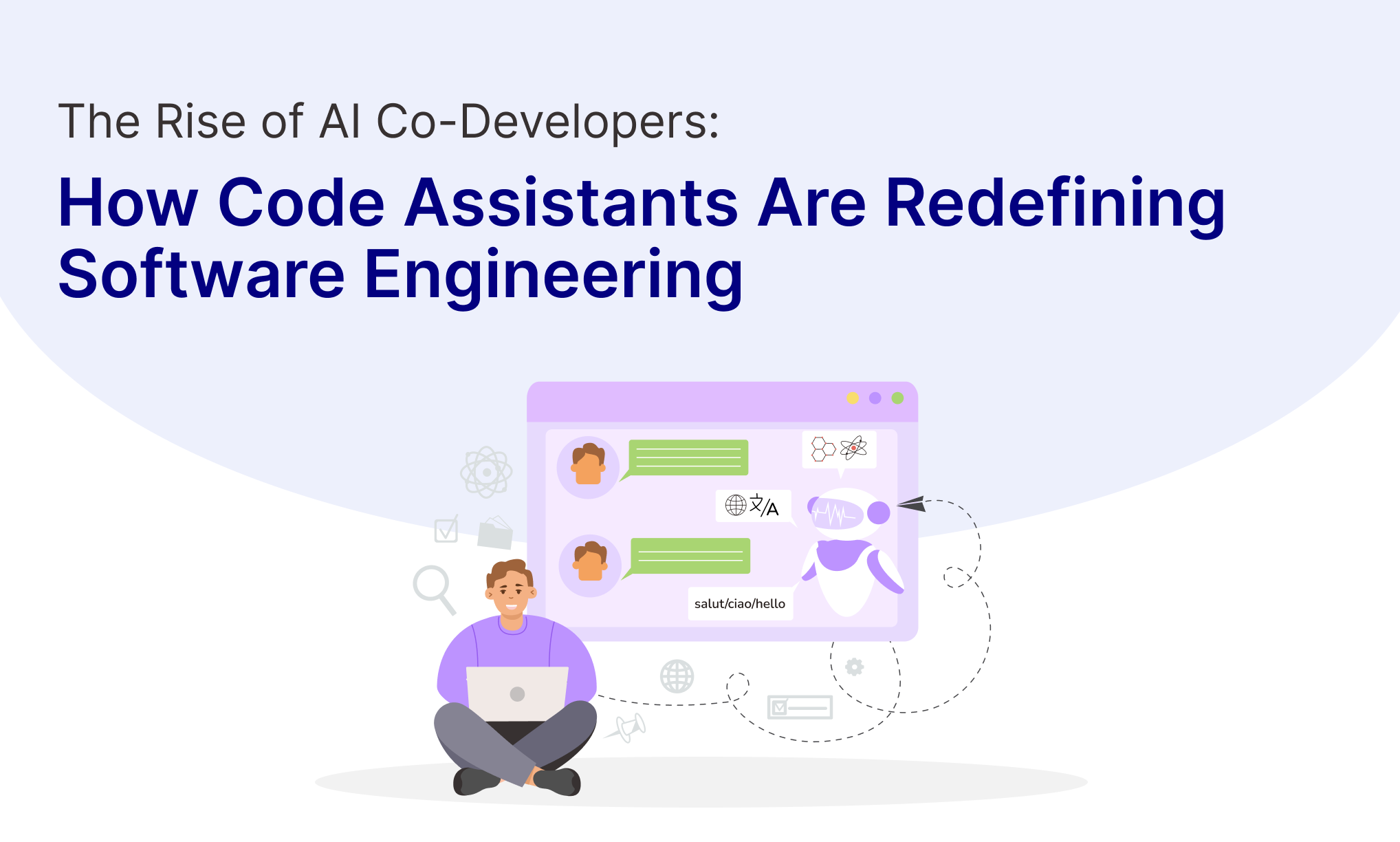
Software development is entering a new phase — one where developers are no longer coding alone. AI-powered assistants, such as Claude Code, GitHub Copilot, and Codex, are quietly transforming the way applications are built, learned, and deployed.
In a recent internal demo, a small app featuring Svelte (frontend), Java (backend), and Gen AI features like RAG and OCR was developed in under a week — by someone new to Svelte and working outside their core stack.
What once would have taken weeks of setup, learning, and debugging now requires only a few hours each day — largely due to the power of AI-assisted coding.
Speed Meets Capability
AI assistants today go far beyond autocomplete. They understand natural language instructions, generate project scaffolding, suggest integrations, and even explain unfamiliar frameworks.
Developers can describe intent in plain English: “Build a responsive Svelte interface that connects to a Java backend and includes Gen AI-based document analysis.”
And within minutes, they get functional, structured code to iterate upon.
This fundamentally changes what “speed to prototype” means. The focus shifts from writing every line of code to guiding AI toward a coherent outcome.
The End of Steep Learning Curves
Perhaps the most empowering shift is the removal of learning barriers. Developers can now explore unfamiliar frameworks or languages without deep prior experience.
AI tools provide explanations, documentation snippets, and instant feedback — enabling developers to build while they learn.
This ability to fluidly move across technologies promotes innovation, experimentation, and faster skill adoption.
The Developer’s Role Is Evolving
AI isn’t replacing developers — it’s augmenting them. Developers remain responsible for architecture, logic, and business intent, while AI accelerates the mechanics of execution.
In this new paradigm, Architects focus on design and alignment with business goals. – Developers evolve into curators of AI-generated code. – Teams spend more time testing, refining, and improving — not scaffolding.
It’s not less coding; it’s smarter coding.
A Collaborative Future
The future of software engineering lies in collaboration — not just between people, but between people and intelligent systems.
AI assistants are becoming key partners for:
- Rapid prototyping
- Learning unfamiliar frameworks
- Integrating AI and automation capabilities
- Reducing boilerplate and syntax overhead
As these tools continue to mature, the act of programming will become more about communicating intent and less about writing syntax.
In essence, the next wave of innovation will come from those who can prompt precisely, design thoughtfully, and iterate creatively.
Conclusion
AI coding assistants represent more than a productivity boost — they’re redefining the craft of software creation itself.
Developers who embrace these tools are no longer bound by time, syntax, or steep learning curves. They’re free to focus on what truly matters: turning ideas into working solutions — faster, smarter, and with a little help from AI.
Curious about AI-assisted development? Start exploring these tools today and see how they can accelerate your next project.