Introduction
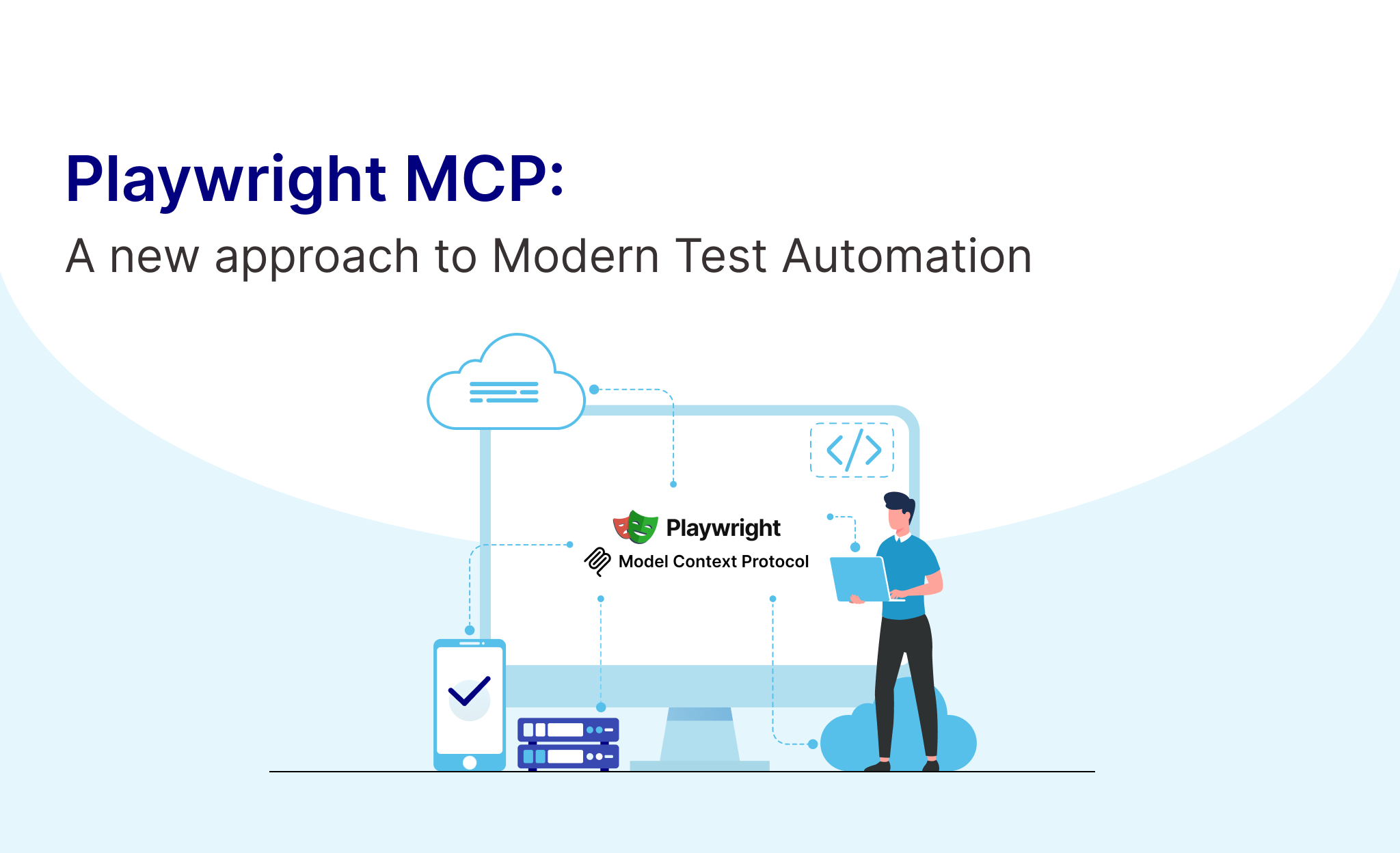
Testing and delivering high-quality applications at scale is a constant challenge. Traditional Test Automation, while powerful, often struggles with limitations such as dynamic user interfaces, flaky tests, and time-consuming script maintenance. To answer these, Playwright MCP (Model Context Protocol) comes into the picture.
This blog will talk about how Playwright MCP and GenAI work together to streamline QA processes, boost efficiency, and empower testers to focus on strategic tasks.
How the Model Context Protocol (MCP) Server Works
Model Context Protocol (MCP), as described, is an open-source protocol developed by Anthropic to create a consistent method for LLMs to interact with external systems, such as the Web, databases, APIs, etc. There are different types of MCP servers, of which the most commonly used one when it comes to Test Automation is the Playwright MCP Server, which enables LLMs or agents to control a Playwright-managed browser using structured commands.
About Playwright MCP
Playwright MCP is a server that acts as a bridge between large language models (LLMs) or other agents and Playwright-managed browsers. It enables structured command execution, allowing AI to control web interactions like navigation, form filling, or assertions. What sets MCP apart is its reliance on the browser’s accessibility tree — a semantic, hierarchical representation of UI elements—rather than screenshot-based visual interpretation.
In summary, MCP provides real-time accessibility snapshots, detailing roles (e.g., button, Input text field), labels (e.g., “Submit”), and states (e.g., enabled/Disabled). This approach is lightweight and precise, unlike Vision Mode, which uses screenshots for custom UIs but is slower and less reliable. By prioritizing the accessibility tree, MCP delivers unparalleled speed, reliability, and resource efficiency.
GenAI + Playwright MCP: A Game-Changer
Combining GenAI with Playwright MCP unlocks a new paradigm for test automation.
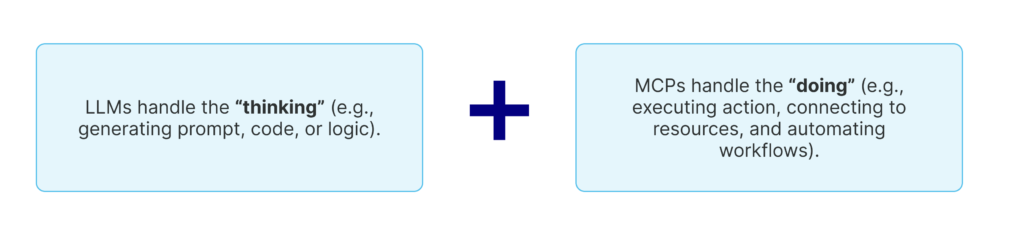
This combination provides the following features that have long been a pain point for QA teams.
Here’s a list-
- Natural Language Test Creation
Test cases can be written in plain English without touching a line of code. With GenAI and Playwright MCP, testers can describe scenarios like, “Navigate to the login page, enter valid credentials, and verify the dashboard loads.” The AI interprets this via MCP, generating Playwright executable scripts.
- Self-Healing Tests
UI changes, such as a renamed button or an updated selector, are a leading cause of test failures. GenAI, powered by Playwright MCP, analyses the DOM in real-time and adapts scripts to these changes. For example, if a button’s ID changes from “submit-btn” to “login-btn”, the AI detects the new context and updates the script, saving hours of manual maintenance.
- Dynamic Test Adaptation
Modern applications often behave differently based on user context. Playwright MCP enables GenAI to understand these variations and adjust test flows dynamically, ensuring comprehensive coverage without redundant scripts.
- Faster Test Case Generation
GenAI can analyse an application’s behaviour and suggest test cases for edge cases or failure-prone areas. For instance, it might propose negative test cases for testing a form’s error handling for invalid inputs, which Playwright MCP then converts into Playwright tests. This reduces the time to achieve high test coverage.
- Scalability and Integration
Playwright MCP can be integrated seamlessly with CI/CD pipelines (e.g., GitHub Actions, Jenkins) and tools like Claude Desktop or Cursor IDE.
Most popular AI agents that are often used with Playwright MCP are Claude Sonnet, Copilot, GPT, and AmazonQ.
Challenges and Limitations
While Playwright MCP proves to be a boon for Testers and provides a way of Modern Test Automation, several limitations make it not suitable for enterprise-scale automation needs. Here are a few points to consider-
- Playwright MCP is primarily designed for testing scenarios. It lacks enterprise features like CAPTCHA solving, two-factor authentication, and complex workflow chaining that businesses need for production automation.
- It depends heavily on external LLM services, which could lead to high token usage costs. Large or complex Business requirements can flood the LLM’s context window with accessibility data, leading to truncation and errors.
- Users must provide very specific and clear LLM prompts. Slight wording changes can lead to different results.
- AI reasoning and test case generation may sometimes take time for complex business scenarios, making overall test execution slower.
- It requires technical expertise for setup and lacks enterprise security features.
Conclusion
As software development cycles become increasingly rapid and complex, there is a high need for smarter and more resilient test automation. The fusion of Gen AI and Playwright MCP marks a pivotal step forward, enabling teams to automate with greater speed, precision, and adaptability. By minimizing maintenance overhead and intelligently handling dynamic interfaces, this powerful combination not only enhances test coverage but also frees up QA professionals to focus on high-value and strategic activities.
Transform your testing workflow with Playwright MCP and GenAI, and take the next step toward intelligent test automation.