In today’s fast-evolving manufacturing environment, understanding how parts, sub-assemblies, and products interconnect is crucial. Traditional systems often fall short when complexity, agility, and speed of insights are required. This is where Graph Databases like Neo4j and Generative AI (GenAI) redefine the game.
This blog explores how these two technologies—when integrated smartly—can supercharge manufacturing intelligence. Whether you’re an engineer solving operational problems or an architect designing intelligent systems, there’s something here for you.
Why Manufacturing Needs This
Modern manufacturing is a high-stakes environment where minor disruptions can cascade into major financial losses. Consider these real-world scenarios:
- A single faulty capacitor triggers a domino effect, leading to failures across ten different product lines.
- Your entire product shipment is delayed for weeks because of a single-source chip that has become unavailable.
- A legacy part version, despite being officially replaced by a newer iteration, remains in circulation, causing performance and compatibility issues.
These problems often fly under the radar until the damage is done. The solution lies in a system that not only comprehends the complex web of dependencies within your manufacturing process but can also communicate these insights clearly and intuitively. This is precisely where the combined power of Neo4j and GenAI delivers unparalleled value.
Where Neo4j + GenAI Add Value
1. Fault Impact Analysis
- Neo4j helps you map out the entire part-to-product lineage.
- GenAI summarizes findings in human-readable language. “Capacitor C-117 impacts 3 sub-assemblies and 7 final products including XPhone and SmartRouter.”
2. Natural Language Querying
- Engineers ask, “Which products will be delayed if chip CH-22 is unavailable?”
- GenAI translates the question into Cypher queries and returns visual/structured results.
3. Dependency-Aware Part Replacement
- Neo4j uses REPLACED_BY relationships.
- GenAI suggests alternate parts based on sourcing history and prior replacements.
4. Risk & Sourcing Analysis
- Detect single-vendor parts and alert stakeholders early.
- Visualize risk areas in your supply graph.
5. Version & Lifecycle Tracking
- Identify outdated components that are still in use.
- Forecast replacements based on historical patterns.
Architectural Challenges & How This Solution Helps
As an architect, implementing such a system requires more than just data modeling. Here’s how Neo4j + GenAI—and cloud-native tools like Amazon Bedrock—help address architectural pain points:
1. Data Fragmentation & Integration
- Challenge: ERP, PLM, QA, and supplier data are siloed.
- Solution: Neo4j ingests data via flexible APIs (Python/Node.js), representing them as a connected graph without enforcing rigid schemas.
2. Real-Time Performance at Scale
- Challenge: Deep joins on BoMs are expensive in RDBMS.
- Solution: Graph traversal in Neo4j is optimized for such queries. Use Neo4j Aura for horizontal cloud scaling.
3. AI-Driven Interfaces
- Challenge: Business wants chat-based insights, not query builders.
- Solution: Use Amazon Bedrock to:
- Host LLMs like Claude, Titan, or Llama
- Run prompt orchestration workflows
- Manage prompt safety, context length, and response reliability
4. Security, Governance & Observability
- Challenge: AI models must be audited and secured.
- Neo4j supports role-based access and auth providers like OAuth2.
- Bedrock integrates with CloudWatch, CloudTrail, and Guardrails for prompt monitoring and anomaly detection.
Reference Architecture
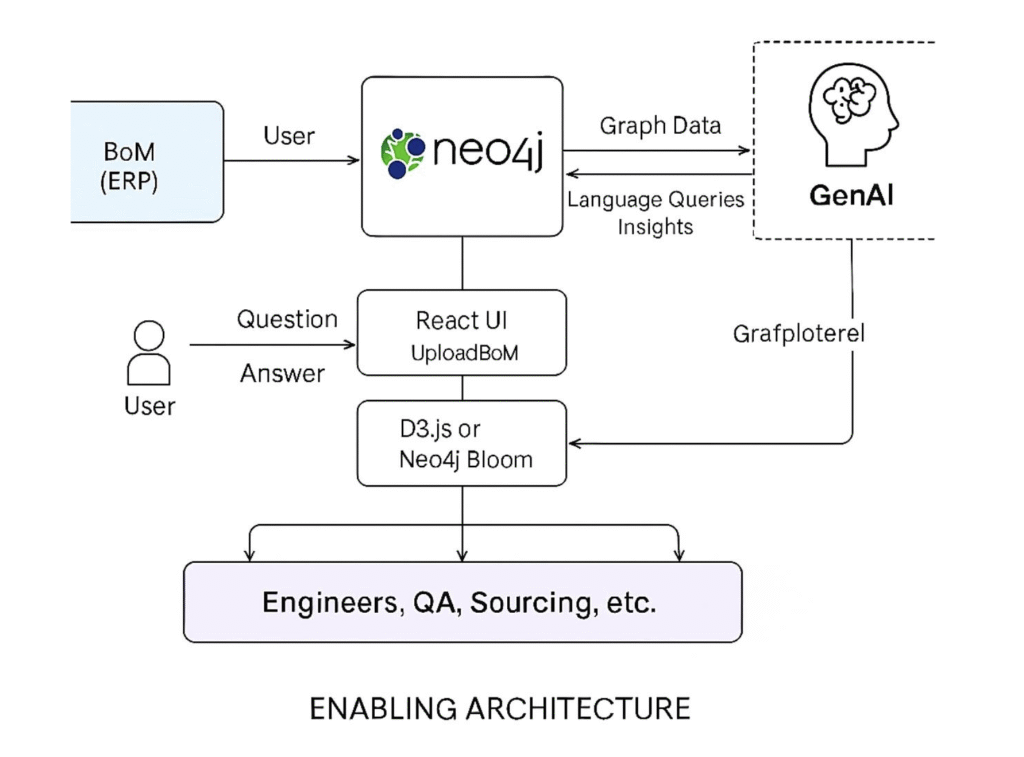
What’s Ahead: The Future is Integrated
This is just the beginning. The foundation of Neo4j and GenAI opens the door to even more advanced capabilities, including:
- Real-time supply chain feed integration
- Predictive maintenance alerts
- Automated workflow connectors with tools like Slack and Jira
- Bi-directional synchronization with PLM systems
Final Thoughts: Why This Matters to Architects
This is more than just a blog—it’s a blueprint for an intelligent, extensible architecture. By following this model, you can:
- Model the true complexity of your manufacturing data with Neo4j.
- Enable powerful natural-language analytics through Bedrock-hosted GenAI.
- Deliver systems that are scalable, secure, and tailored to specific user roles.
- Design for the needs of both domain users and technical stakeholders.
Graphs reveal structure. GenAI reveals meaning. Together—they power intelligent manufacturing.
Ready to build the next generation of intelligent manufacturing solutions? Start exploring, experiment with real-world use cases, and discover how this powerful combination can drive measurable business impact.