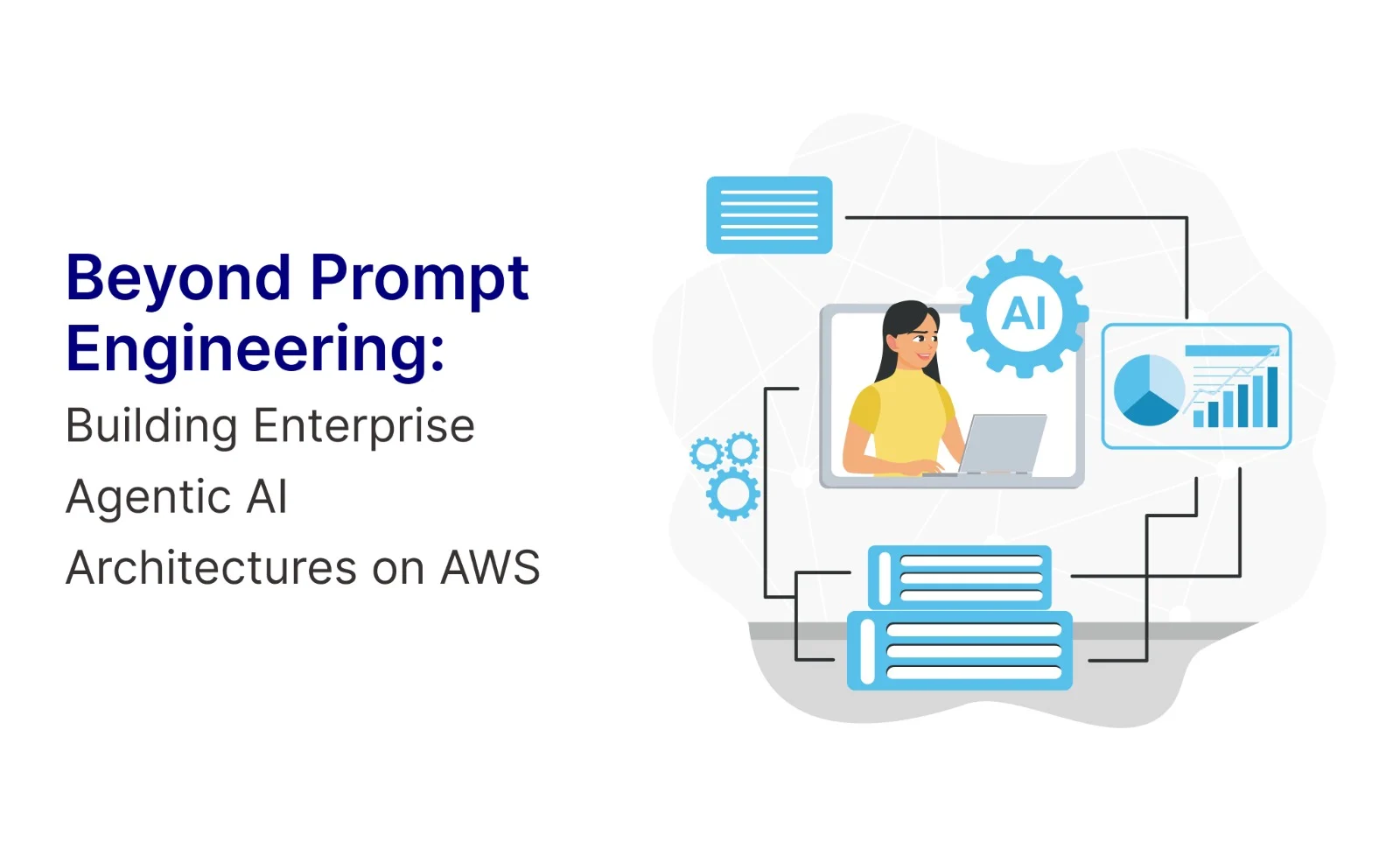
Large Language Models (LLMs) have transformed how organizations interact with information, automate tasks, and enhance user experiences. However, many enterprise AI implementations remain fundamentally limited by a prompt-centric architecture where reasoning, workflow orchestration, memory management, and system integration are handled outside the model.
As organizations move beyond simple chat interfaces and toward autonomous business workflows, a new architectural pattern is emerging: Agentic AI.
Agentic AI systems can reason, plan, interact with enterprise systems, coordinate specialized agents, maintain memory, and adapt dynamically as conditions change. These capabilities enable enterprises to automate complex business processes that traditionally required significant human intervention.
This article explores an AWS-native Agentic AI architecture designed for enterprise-scale deployments, highlighting planning strategies, multi-agent coordination, memory management, tool integration, governance controls, and operational best practices.
Why Traditional Prompt Engineering Reaches Its Limits
Most enterprise AI solutions today follow a straightforward pattern:
- A user submits a request.
- An LLM processes the prompt.
- A response is returned.
While effective for many conversational use cases, this approach struggles when workflows require:
- Multi-step decision making
- Long-running execution
- Enterprise system integration
- Context preservation
- Error recovery
- Compliance validation
Consider a customer onboarding workflow in a financial institution.
The process may require:
- Identity verification
- Compliance screening
- Risk assessment
- Account provisioning
- Customer notifications
- Audit logging
Attempting to execute such a workflow through a single prompt quickly becomes difficult to manage and govern.
Agentic AI addresses this challenge by combining reasoning, orchestration, memory, and tool execution into a coordinated system capable of autonomous task completion.
From Prompt-Based AI to Agentic AI
The key distinction between traditional AI applications and Agentic AI systems lies in how work is executed.
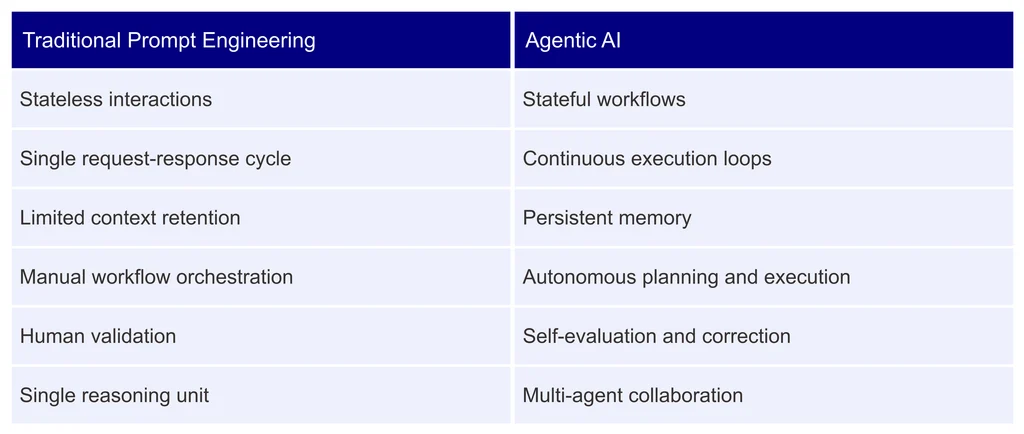
Instead of attempting to solve every problem through a single prompt, Agentic systems continuously plan, execute, observe outcomes, and adjust their strategy until objectives are achieved.
Enterprise Agentic AI on AWS
A production-grade Agentic AI platform should separate reasoning, orchestration, memory, communication, and tool execution into independent architectural layers.
At a high level, the architecture consists of:
- Cognitive reasoning layer
- Orchestration layer
- Multi-agent coordination framework
- Memory fabric
- Tool execution layer
- Governance and security controls
- Observability and operations
AWS managed services provide a strong foundation for implementing each layer while maintaining scalability, security, and operational resilience.
Step 1: Reasoning and Planning with Amazon Bedrock
The cognitive layer is powered by foundation models hosted on Amazon Bedrock, such as Anthropic Claude or Amazon Titan.
Unlike traditional chatbot implementations, the model is responsible for:
- Intent analysis
- Goal decomposition
- Task planning
- Tool selection
- Structured decision generation
Example: Customer Onboarding
When a customer onboarding request is received, the reasoning layer may decompose the objective into:
- Verify customer identity
- Perform KYC screening
- Assess fraud risk
- Create customer account
- Notify customer
- Record audit trail
Rather than solving the entire problem in a single step, the objective is transformed into a structured execution plan.
Step 2: Planning, Reasoning, and Adaptive Execution
Enterprise workflows rarely proceed exactly as expected.
Services become unavailable, data may be incomplete, and compliance checks can fail unexpectedly.
To operate effectively in dynamic environments, agents continuously evaluate:
- Progress toward objectives
- Tool responses
- Confidence levels
- Governance constraints
- Cost and latency requirements
Many organizations implement reasoning patterns such as:
- ReAct (Reason + Act)
- Plan-and-Execute
- Graph-Based Planning
- Reflection Loops
These approaches enable agents to reassess decisions as execution progresses.
Adaptive Replanning
Suppose a compliance screening service becomes unavailable.
Rather than terminating the workflow, the agent may:
- Select an alternative tool
- Query another data source
- Escalate for approval
- Generate a revised execution plan
This ability to adapt is one of the defining characteristics of Agentic AI systems.
Step 3: Multi-Agent Collaboration
As workflows become more complex, a single agent often becomes difficult to scale and govern.
Enterprise architectures increasingly distribute responsibilities across specialized agents.
Typical roles include:
- Supervisor Agent
- Research Agent
- Execution Agent
- Validation Agent
- Domain-Specific Agents
Popular frameworks such as LangGraph, CrewAI, Microsoft AutoGen, Semantic Kernel, and Amazon Bedrock Agents can be used to implement these coordination patterns. While implementation details vary, the underlying architectural principles of planning, delegation, collaboration, and validation remain consistent across frameworks.
Example Workflow
For customer onboarding:
Supervisor Agent
- Receives the onboarding request
- Creates the execution plan
- Coordinates participating agents
Compliance Agent
- Executes KYC screening
Risk Agent
- Performs fraud assessment
Provisioning Agent
- Creates customer accounts
Validation Agent
- Verifies workflow completion
The Supervisor Agent aggregates results and determines final workflow status.
All participating agents operate against a shared workflow state, ensuring that decisions, execution progress, and outcomes remain synchronized throughout the workflow. This shared state enables coordinated execution across specialized agents while maintaining governance and traceability.
Step 4: Agent-to-Agent Communication
Agent collaboration requires reliable communication mechanisms.
Rather than exchanging free-form text, agents communicate using structured messages containing:
- Task identifiers
- Objectives
- Status updates
- Results
- Confidence scores
- Validation outcomes
On AWS, communication can be coordinated through:
- AWS Step Functions
- Amazon EventBridge
- Amazon SQS
- Shared workflow state in DynamoDB
Structured communication improves traceability, governance, and operational reliability.
On AWS, agent communication can be implemented using event-driven services such as Amazon EventBridge and Amazon SQS, while AWS Step Functions manages workflow transitions and execution state. This approach decouples agents, improves scalability, and enables resilient coordination across distributed workflows.
Step 5: Memory as a Strategic Enterprise Asset
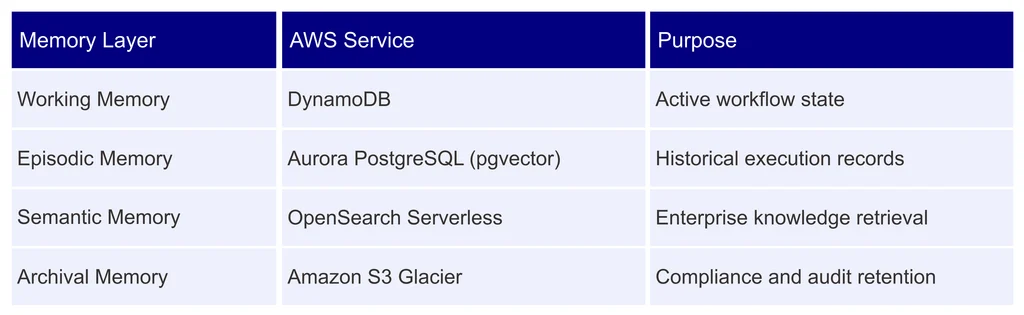
Memory is one of the most important differentiators between traditional AI systems and Agentic AI architectures.
Rather than maintaining a single conversation history, enterprise platforms typically implement multiple memory layers.
Memory Retrieval
Before execution begins, agents retrieve context based on:
- Relevance
- Recency
- Confidence
- Business priority
Memory Ranking and Prioritization
Not all stored information is equally valuable during execution. Retrieved context is ranked using factors such as relevance, recency, confidence, business priority, and historical usefulness. By prioritizing the most valuable information, agents can improve reasoning quality while minimizing context-window consumption and token costs.
Memory Optimization
To prevent excessive token consumption:
- Older interactions are summarized
- Low-value records are pruned
- Long-running sessions are compressed
- Historical outcomes are ranked for retrieval
This ensures that agents retain useful context without overwhelming model context windows.
Step 6: Tool Discovery and MCP-Based Integration
Enterprise agents rarely operate in isolation.
They interact with:
- CRM platforms
- ERP systems
- Databases
- Internal APIs
- SaaS applications
The Model Context Protocol (MCP) provides a standardized interface for exposing tools to agents.
Tool Registry
A centralized registry maintains metadata including:
- Tool capabilities
- Input/output schemas
- Permission requirements
- Security classifications
- Health status
Tool Health Monitoring
Enterprise environments often contain hundreds of tools and services with varying availability and performance characteristics. Tool registries continuously monitor health, latency, error rates, and historical reliability to prevent degraded or unavailable tools from being selected during execution.
Tool Selection
When an agent needs to perform an action, candidate tools are evaluated based on:
- Capability match
- Historical success rate
- Latency
- Cost
- Security requirements
On AWS, MCP services can be hosted using Amazon ECS and AWS Fargate, providing isolated and scalable execution environments.
Step 7: Self-Evaluation and Failure Recovery
Enterprise AI systems cannot assume that every execution succeeds on the first attempt.
Agentic architectures incorporate continuous evaluation mechanisms that verify:
- Objective completion
- Output consistency
- Policy compliance
- Tool execution success
- Confidence thresholds
When validation fails, agents may:
- Retry execution
- Select alternate tools
- Replan workflows
- Request additional information
- Escalate to human reviewers
Execution traces are persisted for future analysis, enabling continuous improvement over time.
Step 8: Human-in-the-Loop Governance
Despite advances in autonomous reasoning, certain enterprise actions still require human oversight.
Examples include:
- Financial approvals
- Regulatory decisions
- Contract modifications
- High-risk customer actions
AWS Step Functions can introduce approval checkpoints where human reviewers validate recommendations before execution continues.
This approach balances autonomy with governance and risk management.
5. Security and Governance by Design
Enterprise Agentic AI systems must operate within strict security boundaries.
Key controls include:
Guardrails for Amazon Bedrock
- Content filtering
- PII protection
- Prompt injection mitigation
- Policy enforcement
Zero-Trust Execution
- Least-privilege IAM access
- Isolated execution environments
- Restricted network boundaries
Auditing and Compliance
- AWS CloudTrail
- Amazon CloudWatch
- AWS X-Ray
- Amazon S3 Glacier
Together, these services provide visibility into agent decisions, tool usage, workflow execution, and compliance posture.
End-to-End Workflow Example
To illustrate how these components work together, consider a customer onboarding workflow:
- A customer onboarding request enters the platform through Amazon API Gateway.
- The Supervisor Agent receives the objective and generates an execution plan.
- Relevant customer context and historical interactions are retrieved from the memory layer.
- The Compliance Agent performs KYC screening using registered enterprise tools exposed through MCP.
- The Risk Agent evaluates fraud indicators and validates risk policies.
- Results are persisted to memory and shared with participating agents.
- The Validation Agent reviews execution outcomes against predefined success criteria.
- If validation fails, the Supervisor Agent initiates replanning, retries execution, or selects alternative tools.
- For high-risk decisions, the workflow may enter a human approval stage.
- Upon successful completion, results are persisted, audit records are archived, and the customer is notified.
This workflow demonstrates how reasoning, planning, memory, tool integration, agent collaboration, governance, and observability operate together within a production-grade Agentic AI architecture.
To illustrate how these components work together, consider a customer onboarding workflow:
- A customer onboarding request enters the platform through Amazon API Gateway.
- The Supervisor Agent receives the objective and generates an execution plan.
- Relevant customer context and historical interactions are retrieved from the memory layer.
- The Compliance Agent performs KYC screening using registered enterprise tools exposed through MCP.
- The Risk Agent evaluates fraud indicators and validates risk policies.
- Results are persisted to memory and shared with participating agents.
- The Validation Agent reviews execution outcomes against predefined success criteria.
- If validation fails, the Supervisor Agent initiates replanning, retries execution, or selects alternative tools.
- For high-risk decisions, the workflow may enter a human approval stage.
- Upon successful completion, results are persisted, audit records are archived, and the customer is notified.
This workflow demonstrates how reasoning, planning, memory, tool integration, agent collaboration, governance, and observability operate together within a production-grade Agentic AI architecture.
Architecture Diagram
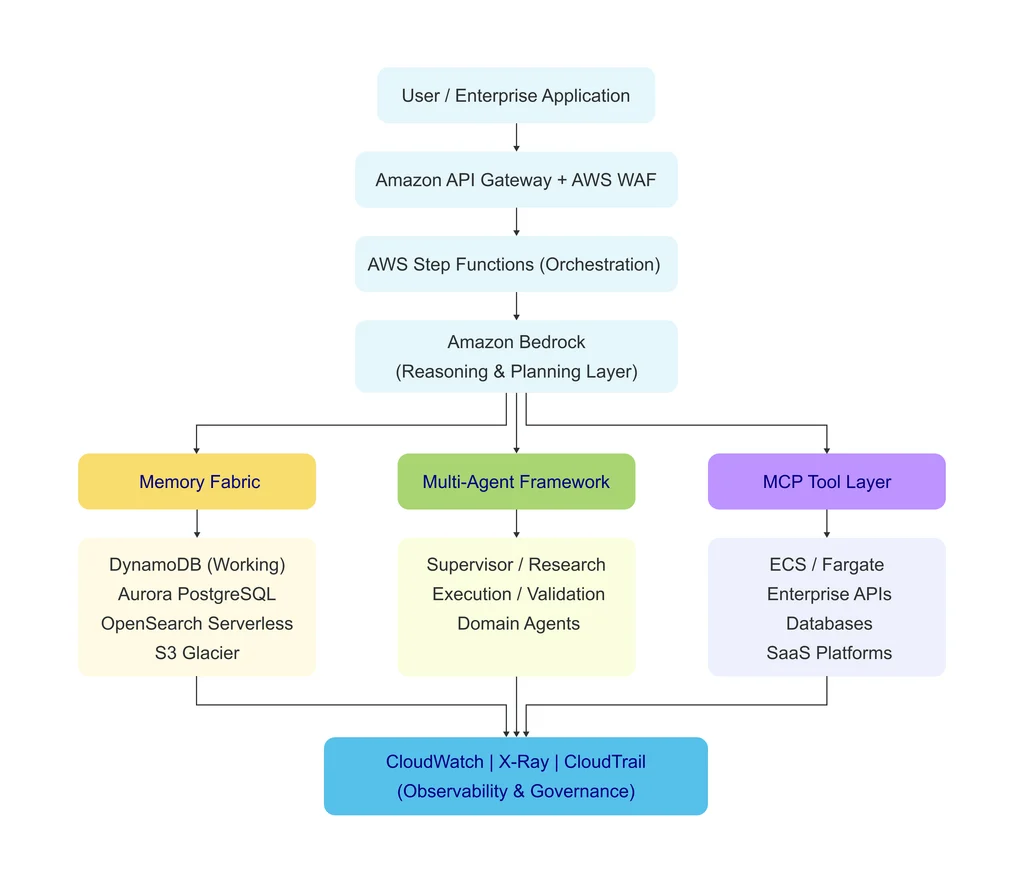
AWS Reference Architecture
A production implementation typically consists of six logical layers:
- Interface and Safety Edge
- Orchestration Core
- Cognitive Intelligence Layer
- Tool Execution Abstraction Layer
- Multi-Tier Memory Fabric
- Governance and Operations Layer
Each layer contributes to secure, observable, and scalable autonomous workflows while maintaining enterprise governance requirements.
8. Implementation Roadmap
Organizations can adopt Agentic AI incrementally.
Phase 1 – Foundation and Security
- Deploy Amazon Bedrock
- Establish guardrails
- Secure tool integrations
Phase 2 – Orchestration and Memory
- Implement AWS Step Functions
- Introduce memory services
- Enable knowledge retrieval
Phase 3 – Multi-Agent Expansion
- Deploy specialized agents
- Introduce agent communication patterns
- Implement self-evaluation mechanisms
Phase 4 – Optimization and Governance
- Add human approval workflows
- Implement advanced observability
- Optimize model routing and cost controls
Conclusion
Agentic AI represents a significant evolution beyond prompt engineering. By combining reasoning, planning, memory, multi-agent collaboration, tool integration, and governance controls, organizations can automate increasingly complex business processes while maintaining security and compliance.
AWS provides a comprehensive set of managed services—including Amazon Bedrock, AWS Step Functions, DynamoDB, OpenSearch, Aurora PostgreSQL, ECS, and CloudWatch—that enable enterprises to build scalable and production-ready Agentic AI platforms.
As organizations move from experimentation to enterprise adoption, the focus shifts from writing better prompts to designing intelligent systems capable of planning, acting, learning, and adapting autonomously.